
Psoriasis and Stress: Breaking the Flare Cycle
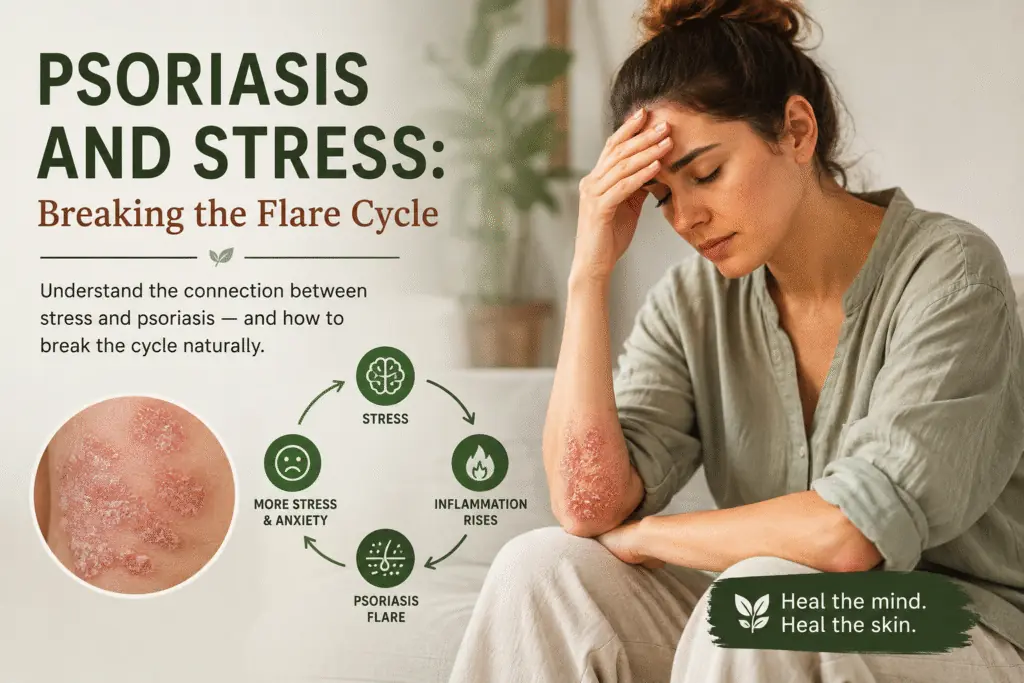
Stress and Psoriasis are closely connected. Stress does not create psoriasis on its own, but it is one of the most common triggers for a flare and it reliably makes existing patches worse. Chronic stress raises inflammation, disturbs sleep, and weakens the skin barrier, which is exactly the combination psoriasis feeds on. The link also runs both ways: a visible flare raises stress, and that stress drives the next flare. Breaking the cycle means treating the mind and the skin together, not one after the other.
Introduction
You had a hard week at work. You slept badly for three nights. And by Sunday morning, the patches on your elbows are angrier and itchier than they have been in months.
If that sounds familiar, you are not imagining things.
The connection between psoriasis and stress is one of the best-documented patterns in this condition. Stress makes your skin worse. Worse skin makes you more stressed. And the loop keeps turning.
The encouraging part is that this loop has weak points. Once you understand how psoriasis and stress feed each other, you can start breaking the chain in more than one place. This guide walks you through the science, the everyday triggers, and how Ayurveda approaches the problem from the root.
Can Stress Cause Psoriasis?
Stress does not cause psoriasis in the sense of creating the condition from scratch – psoriasis is a chronic, immune-mediated disease rooted in genetics and immune system dysfunction. However, stress is widely recognized as one of the most powerful triggers for both the initial onset of psoriasis and subsequent flare-ups. Up to 80% to 88% of people with psoriasis report that emotional stress directly worsens their symptoms.
And once you already have psoriasis, stress becomes one of the most reliable things that makes it worse. If you want the wider picture, our guide on the causes and symptoms of psoriasis covers the fundamentals.
So the honest answer is this: stress is not the root cause, but it is very often the trigger and the fuel.
What Happens Inside Your Body
To understand stress induced psoriasis, it helps to know what stress actually does under the skin.
When you are under pressure, your body releases stress hormones like cortisol and adrenaline. In short bursts this is useful. It sharpens you and helps you cope.
Chronic stress is a different story. When the pressure never lets up, your stress response system stops working smoothly. Cortisol levels swing out of balance. Your immune system starts producing more inflammatory signals, the same signals that drive psoriasis.
Three things then happen at once:
- Inflammation rises. Your immune system becomes overactive, which is exactly the problem in psoriasis.
- Skin cells speed up. Normally skin cells take around 28 to 30 days to mature. In psoriasis this happens in roughly 8 to 10 days. The cells pile up as scales before the old ones shed.
- Your skin barrier weakens. Stressed skin holds less moisture, so it gets drier, itchier, and easier to irritate.
That is stress induced psoriasis in plain terms. It is not “all in your head.” It is a measurable chain of events running from your nervous system to your skin.
25+ years of Ayurvedic psoriasis care
At Dr. Ambalkar's Ayurvedic Research Centre, we help patients across the Mumbai Metropolitan Region understand whether psoriasis is contagious and treat it at the root. Not sure if you have psoriasis? Let's find out. →
The Flare Cycle: Why Stress and Psoriasis Flare Ups Feed Each Other
Here is where it gets difficult.
Stress and psoriasis flare ups do not move in one direction only. They push each other in a circle:
- Stress builds up.
- Inflammation rises and a flare begins.
- The flare is itchy, visible, and uncomfortable.
- You feel self-conscious, sleep worse, and worry about it.
- That worry becomes more stress.
- The flare gets worse.
Sleep is the hinge in this cycle. Itching keeps you awake. Poor sleep raises stress hormones. Higher stress hormones worsen the itching. Many patients get stuck right here.
Scratching adds another layer. In psoriasis, injured skin can trigger fresh patches in that exact spot, which is why preventing psoriasis from spreading starts with breaking the itch-scratch habit.
Does Anxiety Worsen Psoriasis?
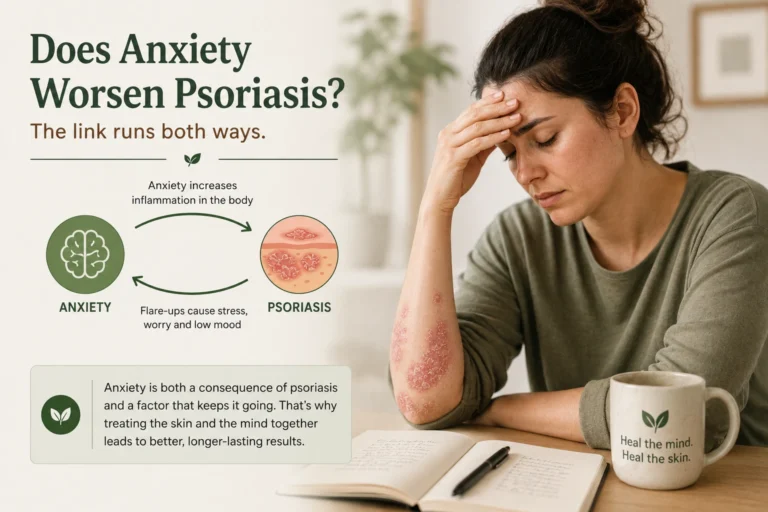
Does anxiety worsen psoriasis, or is it simply a reaction to having it? Research points to both.
Anxiety and low mood are more common in people with psoriasis than in the general population. That makes sense, because a visible and unpredictable skin condition takes a real emotional toll. We have written more about this side of the condition in the everyday struggles psoriasis patients face.
But the traffic runs both ways. Ongoing anxiety keeps the body’s inflammatory response switched on. So anxiety is both a consequence of psoriasis and a factor that keeps it going.
This is why treating skin alone often disappoints. If the mind stays under strain, the skin keeps hearing about it.
Other Psoriasis Triggers Worth Knowing
Stress rarely acts alone. Most flares happen when two or three things stack up in the same week.
Common psoriasis triggers include:
- Infections, especially throat infections, which can set off guttate psoriasis
- Cold, dry weather, which is why many patients notice winter flares
- Skin injury such as cuts, sunburn, insect bites, tattoos, and tight clothing that rubs
- Alcohol and smoking, both linked to more severe and more frequent flares
- Certain medications, including some blood pressure drugs and anti-malarials
- Diet and irregular meals, covered in detail in our guide to foods that trigger a psoriasis flare-up
Knowing your own psoriasis flare up causes is genuinely useful. Keep a simple diary for eight weeks and note your sleep, meals, mood, weather, and skin condition. There are real benefits to tracking your psoriasis symptoms, and patterns usually show up faster than people expect.
How to Stop Psoriasis Flare Ups: Working on Stress
You cannot remove stress from life. But you can change how your body carries it. That is the realistic goal.
Here is what works for most patients:
Protect your sleep. Fix a bedtime. Keep screens out of the last hour. If itching wakes you, moisturise well before bed rather than reaching for the scratch.
Breathe with intention. Slow breathing calms the nervous system within minutes. Ten minutes of pranayama in the morning is a small commitment with a real return.
Move your body gently. Walking, swimming, and yoga all support psoriasis treatment by lowering stress hormones. Avoid punishing workouts during a flare, since heat and friction can irritate skin.
Eat on a rhythm. Regular, warm, simple meals steady both digestion and mood. Skipping meals and eating at midnight does neither any favours.
Talk to someone. A counsellor, a support group, or an honest conversation with family all reduce the load. Isolation makes flares feel much bigger than they are.
Be patient with your skin. Checking your patches ten times a day feeds the anxiety. Look once, treat it, move on. Our six tips for psoriasis skin care cover the daily basics.
Effective stress management for psoriasis patients is not about becoming calm all the time. It is about not letting stress sit unaddressed for months. Learning how to stop psoriasis flare ups usually means acting on the small daily things long before a flare arrives.
Ayurvedic Treatment for Psoriasis: Calming Mind and Skin Together
Ayurveda has described psoriasis-like conditions for centuries under the category of Kushtha, with Ekakushtha and Kitibha Kushtha matching it most closely.
What makes psoriasis treatment in Ayurveda relevant here is its starting assumption: skin problems are rarely only skin problems. They reflect digestion, immunity, sleep, and mental state working together.
In Ayurvedic terms, imbalance in Vata and Kapha affects the blood and skin tissue, while weak digestive fire (agni) allows ama, or metabolic residue, to build up. Persistent mental strain disturbs all of this further. So ayurvedic treatment for psoriasis works on several fronts rather than only the visible patches.
Panchakarma for Psoriasis
Panchakarma is a set of supervised cleansing therapies used to clear accumulated ama and rebalance the doshas.
For skin conditions, Virechana, a therapeutic purgation, is one of the more commonly used procedures. Panchakarma for psoriasis is always tailored. Your body type, current flare, digestion, and general strength all determine what is appropriate and when.
It is a medical process, not a spa treatment. It needs proper assessment and qualified supervision.
Shirodhara for Stress
Shirodhara involves a steady, warm stream of medicated oil poured across the forehead for a set period.
It is one of Ayurveda’s classical answers to a restless mind. Patients typically describe deeper sleep and a noticeably quieter head afterwards. Given how tightly psoriasis and stress are linked, using shirodhara for stress addresses the emotional side of the flare cycle rather than only the skin side.
Takradhara, a variation using medicated buttermilk, is often preferred where there is heat and irritation.
Ayurvedic Remedies for Psoriasis
Alongside therapies, treatment usually includes internal medicines and lifestyle correction.
Herbs traditionally used in ayurvedic remedies for psoriasis include Neem, Manjistha, Guduchi, and Khadira for the skin and blood, along with Ashwagandha and Brahmi to support the mind under stress. If you are curious about the mechanism, we explain how ayurvedic psoriasis medicines work to restore skin health in a separate article.
Diet matters just as much. Most plans reduce sour, fermented, and excessively salty foods, along with milk-and-fish combinations, while building regular meal timing.
Formulations should always be prescribed after a proper Prakriti assessment. Self-medicating with herbs found online is a poor idea with a condition this personal.
Getting the Right Support
Psoriasis is a long-term condition. The realistic aim is sustained control, meaning fewer flares, milder flares, and longer clear periods, rather than a quick fix. This is one reason ayurvedic psoriasis treatment tends to suit long-term management.
That takes an experienced team and a plan built around your body, not a generic protocol.
At Dr. Ambalkar’s Ayurvedic Research Centre, patients travel from across the Mumbai Metropolitan Region for ayurvedic psoriasis treatment in Mumbai, backed by more than 25+ years of focused work on psoriasis and chronic skin conditions. If you have been searching for a psoriasis clinic in Vasai that treats the whole picture rather than only the patches, we would be glad to talk.
Do You Think You Have Psoriasis ?
Get an accurate diagnosis first. Book a Skin Assessment at our Vasai clinic.
- Break the cycle: Psoriasis and stress can fuel each other, but the cycle can be interrupted at any point.
- Calm the mind: Reducing stress can help the skin settle and make flare-ups easier to manage.
- Start with sleep: Prioritise consistent, restful sleep as the first step.
- Practise breathing: Add 10 minutes of breathing exercises to your daily routine.
- Track your triggers: Monitor your sleep, stress, food, and skin changes for two months to identify patterns.
- Get proper guidance: Seek professional support instead of trying to manage psoriasis and stress entirely on your own.
Frequently Asked Questions
1. Can stress make psoriasis worse?
Yes. Stress is one of the most commonly reported triggers among psoriasis patients. It raises inflammation, disturbs sleep, and weakens the skin barrier, and all three push a flare along. Many people notice their skin worsening within days or weeks of a stressful period.
2. Is psoriasis contagious?
No. Psoriasis is not an infection and cannot pass from one person to another. You cannot catch it through touch, sharing a towel, swimming, or close contact. It is driven by your own immune system. We have addressed this in more detail in Is Psoriasis Contagious? Myths vs Facts.
3. Is psoriasis dangerous?
For most people, psoriasis is not life-threatening, but it is more than a cosmetic concern. It can involve the joints in the form of psoriatic arthritis, disturb sleep, and carry a heavy emotional load. Rarer severe forms such as erythrodermic psoriasis need prompt medical attention. Regular review with a qualified practitioner is the safest approach.
4. What does stress-related psoriasis look like?
It usually looks like your existing psoriasis, only worse. Patches become redder, thicker, and itchier, and may spread to new areas. Elbows, knees, scalp, and hands are common sites. Comparing yourself to photographs online can mislead you, because psoriasis varies a great deal between individuals. A proper examination is far more reliable.
5. Can stress cause scalp psoriasis?
Stress does not create scalp psoriasis by itself, but it is a frequent trigger for scalp flares. Many patients first notice it as stubborn dandruff that later thickens into scales. Scalp flares also disturb sleep, which feeds the stress cycle further. Our guide to the best ayurvedic treatment for scalp psoriasis explains the management approach.
6. Can stress induced psoriasis appear on the hands?
Yes. Hands are a common site, partly because they face friction, washing, and chemicals every day. When stress raises overall inflammation, these already vulnerable areas often flare first. Psoriasis affecting the palms and soles is known as palmoplantar psoriasis.
7. Does psoriasis get worse with age?
Not automatically. Psoriasis fluctuates throughout life, with better and worse phases for most people. What tends to change with age is the surrounding context: other health conditions, additional medicines, drier skin, and accumulated stress can all make flares harder to settle. Consistent management matters far more than age itself.
8. What is the best treatment for stress-related psoriasis?
There is no single answer, because it depends on your body type, flare severity, and stress levels. A good plan combines skin treatment with genuine stress work, including sleep correction, breathing practice, diet, and internal medicines. In Ayurveda, this means treating the skin and the mind together rather than separately.
Book a Consultation
If stress keeps pulling your skin back into a flare, you do not have to work it out alone.
Speak with our team at Dr. Ambalkar’s Ayurvedic Research Centre for a personalised assessment covering your skin, digestion, sleep, and stress.
Contact Us to Book an Appointment

Dr. Pramod Ambalkar is an expert Ayurvedic physician and founder of Dr. Ambalkar's Ayurvedic Research Centre (ARC) in Vasai. With 25+ years focused on the Ayurvedic management of psoriasis and chronic skin conditions, he helps patients across the Mumbai Metropolitan Region soothe symptoms and reduce flares through personalised, root-cause care.


