Is Psoriasis Contagious?
Myths vs Facts
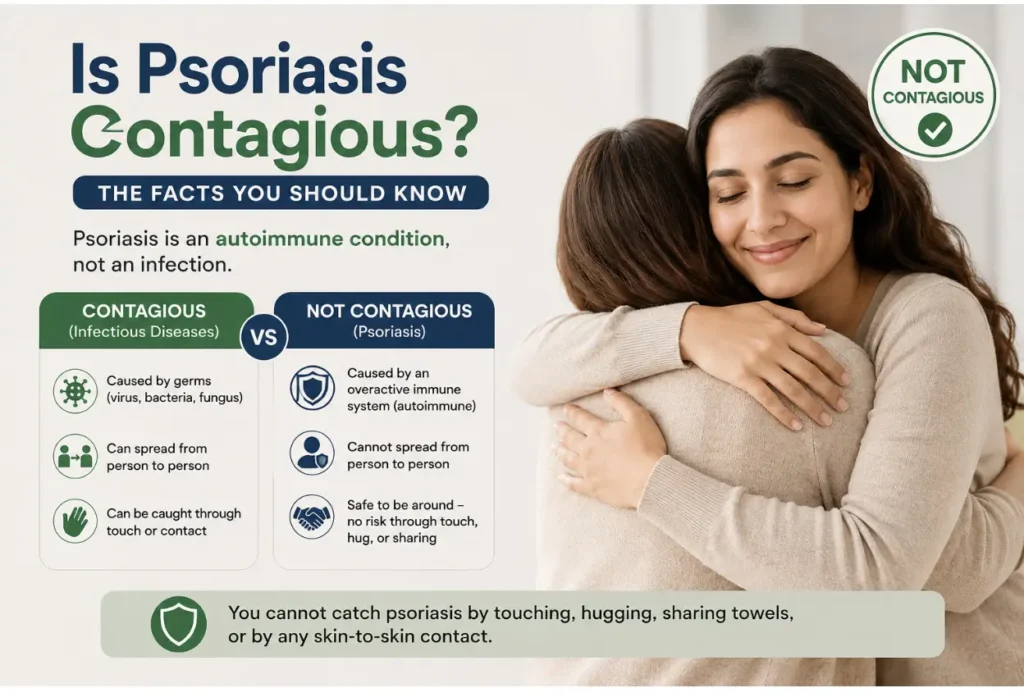
No, psoriasis is not contagious. It cannot spread through touch, hugging, sharing towels, swimming pools, or any form of skin-to-skin or person-to-person contact. Psoriasis is an autoimmune condition, not an infection; it develops because the immune system speeds up skin cell turnover, not because of a virus, bacteria, or fungus that can pass to another person. This holds true for all types, including scalp and nail psoriasis. What can "spread" is the condition on your own body as new patches, not from person to person.
Introduction
If you or someone close to you has just been told it’s psoriasis, one of the first questions that comes up, often before anything else, is is psoriasis contagious. It’s a fair question. Plaques can look raw, scaly or inflamed, and that can naturally raise concerns about touching, hugging or sharing everyday things like towels or cutlery. The short answer is no. Psoriasis is not an infection and cannot be passed from one person to another in any way. This guide breaks down why that’s the case, why psoriasis appears to “spread” across a person’s own skin, what commonly triggers flare-ups, and how it’s actually managed, including the ayurvedic approach we follow at our clinic.
Is Psoriasis a Contagious Disease? (Addressing Touch, Scalp and Nail Psoriasis)
To put it plainly: is psoriasis a contagious disease? No. There is no scientific evidence anywhere that psoriasis transmits from person to person, under any circumstance.
Is psoriasis contagious by touch? No. You cannot catch psoriasis by touching a plaque, shaking hands, hugging, or having other skin-to-skin contact with someone who has it. There’s no infectious agent involved, so there’s nothing to “catch.”
Is hair (scalp) psoriasis contagious? No. Scalp psoriasis doesn’t spread through shared combs, pillows, caps or salon visits. It can look similar to dandruff or a fungal scalp condition, which is often where the confusion comes from, but it works through a completely different, non-infectious mechanism.
Is nail psoriasis contagious? No. Nail psoriasis (pitting, thickening or discolouration of the nails) is sometimes mistaken for a fungal nail infection, which genuinely can spread. Nail psoriasis cannot. The two can even occur together, which is exactly why a proper diagnosis matters. If nail changes are a concern for you, our detailed guide on nail-care tips that can reduce nail psoriasis is worth reading alongside this one.
Is psoriasis spread to others through blood, saliva or intimacy? No. Because it isn’t caused by a transmissible organism, none of the usual routes of disease spread (blood, saliva, sexual contact, coughing) apply to psoriasis.
In short, whether someone asks is psoriasis disease spreadable, is psoriasis a contagious disease, or any variation of the same worry, the medical answer stays the same: it is not.
How Psoriasis Actually Works: Autoimmune vs. Infectious
The confusion around contagion usually comes down to one thing: people assume anything that looks like a rash must be an infection. Psoriasis isn’t. It’s an autoimmune skin condition, and the difference between “autoimmune” and “infectious” is the whole answer to why it can’t spread to another person.
The confusion around contagion usually comes down to one thing: people assume anything that looks like a rash must be an infection. Psoriasis isn’t. It’s an autoimmune skin condition, and the difference between “autoimmune” and “infectious” is the whole answer to why it can’t spread to another person.
An infectious disease needs a pathogen (a virus, bacteria or fungus) that physically moves from one body to another. Psoriasis has no such pathogen. Instead, the immune system mistakenly signals the skin to produce new cells far faster than normal. Skin that should renew over roughly a month instead turns over in a matter of days. Cells pile up on the surface faster than they can shed, forming the thick, raised, scaly plaques associated with psoriasis.
This process is driven from inside the body, shaped by:
- Genetic predisposition – psoriasis often runs in families, and specific genes are linked to a higher likelihood of developing it.
- An overactive immune response – the same immune pathways involved in fighting infection are, in psoriasis, misdirected at the skin itself.
- Systemic inflammation – research increasingly shows psoriasis isn’t only skin-deep; the inflammation involved has links to joint health (psoriatic arthritis) and broader wellbeing.
None of this involves an outside organism entering another person’s body, which is precisely why person-to-person transmission of psoriasis has never been documented.
25+ years of Ayurvedic psoriasis care
At Dr. Ambalkar's Ayurvedic Research Centre, we help patients across the Mumbai Metropolitan Region understand whether psoriasis is contagious and treat it at the root. Not sure if you have psoriasis? Let's find out. →
Why Does Psoriasis Keep Spreading on the Body? (Internal Spreading vs. Catching It)
This is where most of the genuine confusion lives. People notice psoriasis appearing on a new part of their own body, say, moving from the elbows to the scalp or lower back and understandably wonder if it’s “spreading” the way an infection would. It is spreading, technically, but only across your own skin, and it isn’t contagious spread.
Here’s the distinction that matters:
- Internal body spreading: because the underlying trigger is systemic (it originates in the immune system, not the skin surface), new patches can appear in different locations on the same person over time, especially during a flare.
- Catching it from someone else: this simply doesn’t happen with psoriasis, no matter how close the contact.
A related and very common pattern is the plaque psoriasis flare-up, where existing patches thicken and new ones appear in a cluster, often triggered by one of the factors below. If you’d like to understand what commonly sets off this pattern in more detail, we’ve covered practical steps in how to prevent psoriasis from spreading on your own skin.
It’s also worth knowing that psoriasis is frequently confused visually with other skin conditions that behave very differently. We’ve compared the two in detail in our guide on the difference between eczema and psoriasis, which can help if you’re still unsure exactly what you’re dealing with.
Common Triggers: Why Did I Suddenly Get Psoriasis?
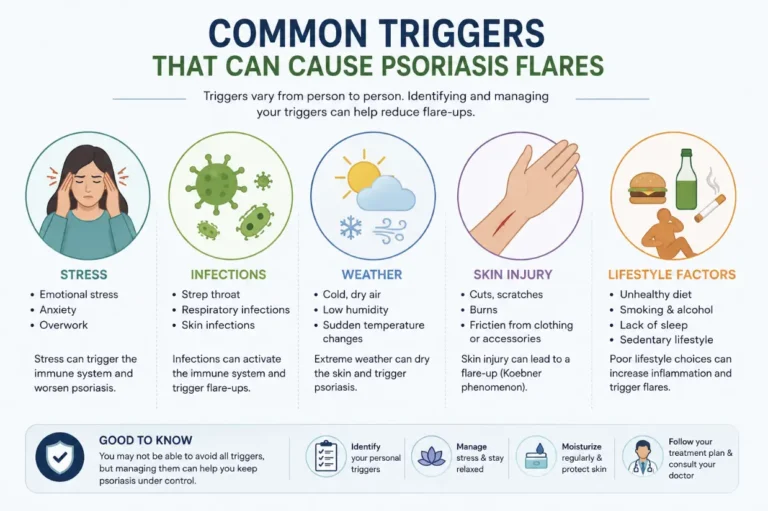
If nothing “gave” it to you, why does psoriasis suddenly appear or flare up? The answer lies in environmental triggers acting on an already-present genetic predisposition. Someone can carry the underlying tendency for years before a trigger switches it on. Common triggers include:
- Stress – one of the most frequently reported flare triggers.
- Infections – ironically, an infection like strep throat can trigger a psoriasis flare (particularly guttate psoriasis) without psoriasis itself being infectious.
- Skin injury – cuts, sunburn or even vaccination-site irritation can prompt new plaques (known as the Koebner phenomenon).
- Weather – cold, dry air tends to worsen symptoms; humidity can help or hinder depending on the person.
- Certain medications – some drugs are known to worsen or trigger flares.
- Lifestyle factors – smoking, alcohol and disrupted sleep are commonly linked to more frequent flares.
Diet is another area people ask about often and we’ve dedicated a full guide to it if you want to go deeper: what foods can trigger a psoriasis flare-up.
Fast-Relief & Management: What Clears Psoriasis Fast?
There’s no single overnight fix for psoriasis (anyone promising instant, permanent clearance should be treated with caution), but flares can be calmed and managed effectively with the right, consistent approach:
- Topical treatments and moisturizers – regular, generous moisturising helps reduce scaling, cracking and discomfort, and is one of the simplest daily habits that makes a visible difference.
- Gentle skin care – lukewarm (not hot) baths, mild cleansers and avoiding harsh scrubbing all help protect the skin barrier.
- Trigger management – identifying and reducing your personal triggers (stress, specific foods, weather exposure) does more for long-term control than any single product.
- Root-cause Ayurvedic care – at our clinic, we look beyond surface symptoms to the internal imbalance (commonly aggravated Vata and Kapha with accumulated toxins, or ama) that’s driving the flare. This includes personalised diet guidance, appropriate detox therapies and medicated applications aimed at longer-term relief rather than temporary suppression.
If you’d like a structured, doctor-guided plan rather than trial and error, our ayurvedic psoriasis treatment page explains how we approach different types of psoriasis, including scalp, nail and plaque psoriasis, at the root.
When To See Doctor
If plaques are spreading quickly, becoming painful, affecting your nails or joints, or you’re simply unsure whether what you have is psoriasis, eczema or a fungal condition, it’s worth getting an accurate diagnosis rather than guessing. A short assessment can rule out look-alikes and put you on the right track early, since the sooner the actual trigger and pattern are understood, the easier flares are to manage.
Do You Think You Have Psoriasis ?
Get an accurate diagnosis first. Book a Skin Assessment at our Vasai clinic.
- Psoriasis is not contagious: it cannot spread by touch, contact, or any form of person-to-person transmission.
- It's an autoimmune skin condition, not an infection, caused by rapid skin cell turnover driven by the immune system.
- Scalp and nail psoriasis are just as non-contagious as plaque psoriasis, even though they're often mistaken for fungal conditions that can spread.
- Psoriasis can spread across your own body over time, which is different from catching it from someone else.
- Flares are driven by triggers like stress, infection, skin injury and weather, layered on top of a genetic predisposition.
- Management combines topical care, trigger control and, in Ayurveda, root-cause treatment rather than only surface suppression.
Frequently Asked Questions
1. Is psoriasis contagious by touch or skin contact?
No. Psoriasis cannot be transmitted through touch, hugging, shaking hands or any other skin-to-skin contact. It is an autoimmune condition, not an infection.
2. Can I get psoriasis from sharing towels, clothes or swimming pools?
No. Since there’s no infectious organism involved, sharing towels, clothing, bedding or using the same pool as someone with psoriasis carries no risk of transmission.
3. Is scalp or nail psoriasis contagious?
No. Both scalp and nail psoriasis work through the same autoimmune mechanism as plaque psoriasis and cannot spread to another person. They’re sometimes confused with fungal conditions of the scalp or nails, which are contagious, and this is why a clear diagnosis matters.
4. Why does my psoriasis seem to be spreading if it’s not contagious?
Because the underlying cause is internal (an overactive immune response), new patches can appear in different areas of your own body over time, especially during a flare. This is spreading on one person’s skin, not transmission between people.
5. Does diet affect how much psoriasis spreads?
Certain foods are commonly reported to worsen flares in some people, though triggers vary individually. See our detailed breakdown of foods that can trigger a psoriasis flare-up for specifics.
6. What skin care routine helps manage psoriasis day to day?
Gentle, fragrance-free moisturising, lukewarm bathing, avoiding harsh scrubbing and identifying personal triggers all help. For a root-cause approach tailored to your skin, our ayurvedic psoriasis treatment programme is built around this.

Dr. Pramod Ambalkar is an expert Ayurvedic physician and founder of Dr. Ambalkar's Ayurvedic Research Centre (ARC) in Vasai. With 25+ years focused on the Ayurvedic management of psoriasis and chronic skin conditions, he helps patients across the Mumbai Metropolitan Region soothe symptoms and reduce flares through personalised, root-cause care.


