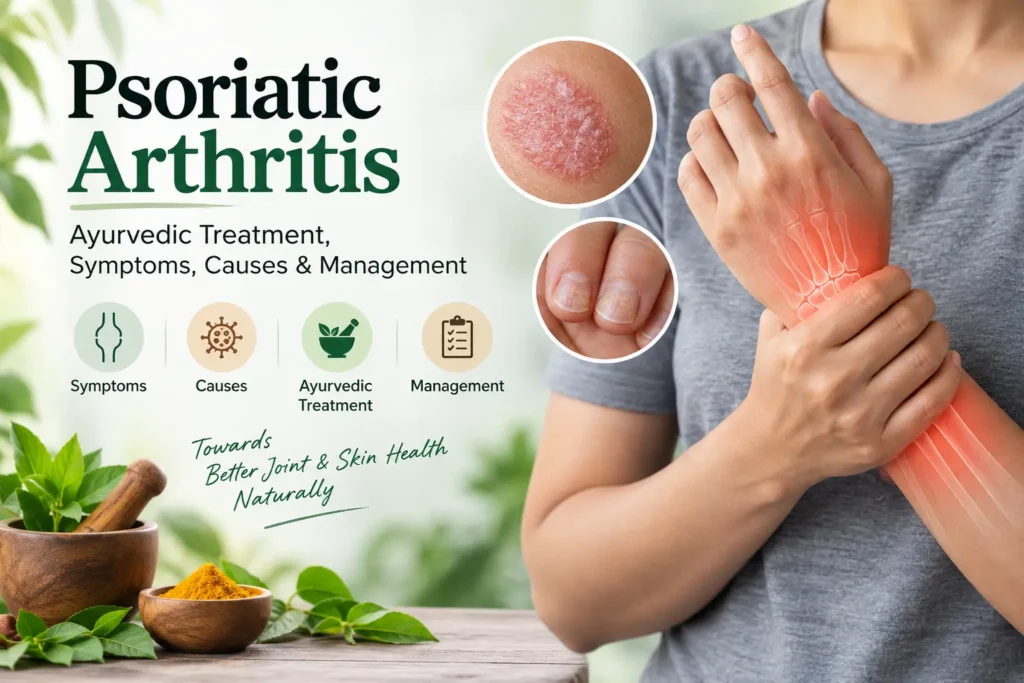
Psoriatic Arthritis: Ayurvedic Treatment, Symptoms, Causes & Management
Psoriatic arthritis is a long-term inflammatory arthritis linked to psoriasis. It causes pain, stiffness and swelling in the joints and where tendons attach to bone. There is no established permanent cure, but early diagnosis and ongoing treatment can control inflammation and help prevent joint damage. Ayurveda approaches it as Vatarakta and may help manage symptoms alongside medical care, though the evidence is still limited.
Introduction
Psoriatic arthritis is a chronic inflammatory arthritis that develops in some people with psoriasis. Psoriasis affects the skin and nails; psoriatic arthritis affects the joints, tendons and ligaments, and both are driven by the same immune-related inflammation. According to the National Psoriasis Foundation, roughly one in three people with psoriasis also develop it, usually years after the skin symptoms begin.
This guide covers its causes, symptoms, types and diagnosis, and what Ayurvedic management involves, including where the evidence is solid and where it is still emerging.
What Is Psoriatic Arthritis?
Psoriatic arthritis is a chronic inflammatory arthritis associated with psoriasis that can affect the joints, tendons and entheses, the areas where tendons and ligaments attach to bone. It is immune-mediated: the immune system mistakenly drives inflammation in healthy tissue.
Psoriasis and psoriatic arthritis are two expressions of one psoriatic disease. Most people develop skin symptoms of psoriasis first; the American Academy of Dermatology notes that joint symptoms typically follow 5 to 12 years later, though a few people have joint symptoms before any rash. It can start at any age, and the severity of the skin disease does not predict the severity of the joint disease.
An Indian study of 1,149 psoriasis patients at PGIMER Chandigarh found psoriatic arthritis in 8.7 percent, and 83 percent of those cases had never been diagnosed before, which is why early recognition matters.
What Causes Psoriatic Arthritis?
Psoriatic arthritis is caused by an overactive immune response that is shaped by genetics and set off by environmental factors. The exact trigger is not fully understood.
- Immune system: it attacks healthy joints and skin by mistake, producing the inflammation behind swelling and pain.
- Genetics: a parent or sibling with psoriatic arthritis raises your risk. Genes such as the one for the HLA-B27 protein are more common in people with the condition, though many carriers never develop it.
- Environmental triggers: an injury or a viral or bacterial infection may set off the disease in someone who is already susceptible.
- Psoriasis: having psoriasis is the biggest single risk factor
Stress, smoking, alcohol, infections, certain medicines and excess weight can worsen flares. Triggers differ from person to person, so learn how to avoid a psoriatic flare-up in your own case.
25+ years of Ayurvedic psoriasis care
At Dr. Ambalkar's Ayurvedic Research Centre, we help patients across the Mumbai Metropolitan Region understand whether psoriasis is contagious and treat it at the root. Not sure if you have psoriasis? Let's find out. →
What Are the Symptoms of Psoriatic Arthritis?
The main symptoms of psoriatic arthritis are joint pain, stiffness and swelling, often worst in the morning or after sitting still. Symptoms vary widely between people and can flare and settle over time.
If you have psoriasis, the earliest warning signs are usually a single swollen finger or toe, morning stiffness that eases with movement, heel pain and new nail pitting. The American Academy of Dermatology advises reporting these to your dermatologist even if they come and go.
Symptom | What it may feel like | Why it matters |
Joint pain and stiffness | Aching, stiff fingers, toes, knees or wrists; stiffness of 30 minutes or more on waking | Ongoing inflammation can damage cartilage and bone |
Dactylitis (sausage digit) | A whole finger or toe swells and feels tight | A hallmark sign of psoriatic arthritis |
Enthesitis | Pain at the heel, sole, elbow or ribs where tendons attach | Affects roughly half of people with the condition |
Nail changes | Pitting, ridging, crumbling or lifting of the nail | Strongly linked with joint involvement; can mimic a fungal infection |
Back or neck pain | Spinal stiffness that is worse after rest | May signal spondylitis (spinal involvement) |
Fatigue | Tiredness out of proportion to activity | Common and often overlooked |
Eye inflammation | Red, painful eyes or blurred vision | Uveitis needs prompt medical attention |
If you already have nail psoriasis, mention any new joint symptoms to your doctor.
What Are the 5 Types of Psoriatic Arthritis?
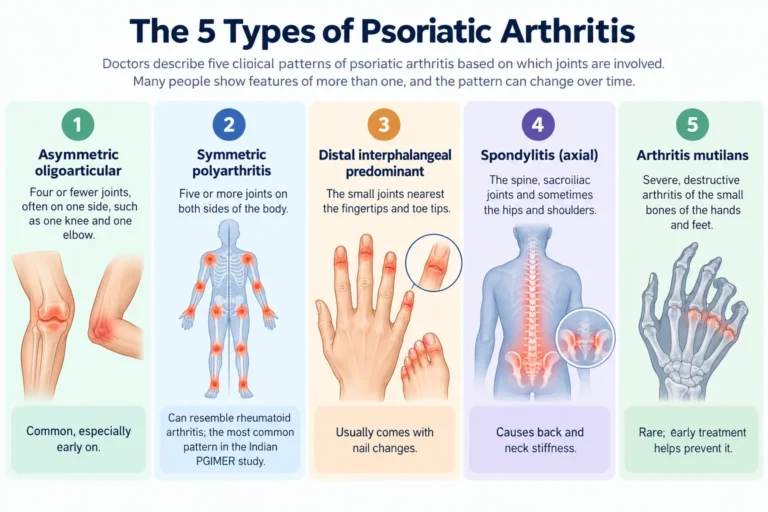
Doctors describe five clinical patterns of psoriatic arthritis based on which joints are involved. Many people show features of more than one, and the pattern can change over time.
Type | What it affects | Notes |
1. Asymmetric oligoarticular | Four or fewer joints, often on one side, such as one knee and one elbow | Common, especially early on |
2. Symmetric polyarthritis | Five or more joints on both sides of the body | Can resemble rheumatoid arthritis; the most common pattern in the Indian PGIMER study |
3. Distal interphalangeal predominant | The small joints nearest the fingertips and toe tips | Usually comes with nail changes |
4. Spondylitis (axial) | The spine, sacroiliac joints and sometimes the hips and shoulders | Causes back and neck stiffness |
5. Arthritis mutilans | Severe, destructive arthritis of the small bones of the hands and feet | Rare; early treatment helps prevent it |
How Is Psoriatic Arthritis Diagnosed?
There is no single blood test that confirms psoriatic arthritis. Diagnosis is clinical: a doctor, ideally a rheumatologist, combines your history, examination, blood tests and imaging while ruling out other causes.
- Medical history, including psoriasis in you or your family and how the symptoms began.
- Examination of the joints, tendons, skin, scalp and nails.
- Blood tests for inflammation markers (ESR, CRP) and to help exclude rheumatoid arthritis and gout; rheumatoid factor is usually negative in psoriatic arthritis.
- X-ray, ultrasound or MRI to detect inflammation or early joint damage.
Because symptoms overlap with rheumatoid arthritis, osteoarthritis and gout, diagnosis can take more than one visit. NIAMS notes that early treatment is associated with better outcomes and less joint damage.
What Is the Ayurvedic Perspective on Psoriatic Arthritis?
In Ayurveda, psoriatic arthritis is most often compared with Vatarakta, a condition in the classical texts in which aggravated Vata dosha and vitiated Rakta (blood) affect the skin and, in its deeper form (Gambhira Vatarakta), the joints and bones. This is a traditional conceptual framework, not a scientifically established one-to-one equivalent of the modern diagnosis.
Practitioners read the scaling and itching as a Vata and Kapha disturbance with accumulated Ama (metabolic toxins), and the joint pain, swelling and stiffness as Vata lodging in the joints with deranged Rakta. Weak digestion (Agni), stress and diet are seen as factors that keep the imbalance active.
Modern medicine explains the same symptoms through immune pathways such as TNF and IL-17. A dosha assessment complements, and never replaces, a rheumatological diagnosis.
Ayurvedic Treatment for Psoriatic Arthritis
Ayurvedic treatment for psoriatic arthritis is individualised and usually combines internal medicines, cleansing therapies, external applications, diet and lifestyle correction. Published evidence is limited to case reports and small open-label studies, so it is supportive care to use alongside, not instead of, medical treatment.
- Individualised Ayurvedic medicines: formulations are matched to the person’s Prakriti and dosha pattern to calm inflammation, support digestion and purify Rakta. A 2025 case report from a CCRAS institute in the Journal of Ayurveda and Integrative Medicine described marked improvement in one patient with psoriatic arthritis and dactylitis, but a single case cannot show what works for everyone. Read more on how Ayurvedic psoriasis medicines work.
- Herbal preparations: commonly used herbs include Neem, Turmeric (Haridra), Guduchi (Giloy), Manjistha and Guggulu. Curcumin from turmeric has reduced inflammation markers in small trials in rheumatoid arthritis and psoriasis, with low-certainty evidence and no psoriatic arthritis trial; the other herbs rest on traditional use. Herbs can interact with prescribed medicines, and some unsupervised Ayurvedic products have been found to contain heavy metals, so use only practitioner-prescribed preparations and tell your rheumatologist what you take.
- Panchakarma: cleansing procedures such as Virechana (therapeutic purgation) and Raktamokshana (bloodletting) are classically used in Vatarakta to clear Ama. They need an assessment of fitness and close supervision, and controlled trials in psoriatic arthritis are lacking.
- External therapies: medicated oil massage (Abhyanga) and herbal applications may ease stiffness and skin dryness; practitioners generally avoid oiling hot, acutely inflamed joints.
- Diet and lifestyle: treated as equal partners to medicine, and covered below.
Do not stop prescribed medicines to begin Ayurvedic treatment. Untreated inflammatory arthritis can cause permanent joint damage, so keep both your rheumatologist and your Ayurvedic doctor informed.
Ayurvedic Diet for Psoriatic Arthritis
An Ayurvedic diet for psoriatic arthritis aims to strengthen digestion, reduce Ama and avoid foods believed to aggravate Vata and Pitta. It is personalised, so no single list suits everyone. Common principles:
- Favour freshly cooked, warm, easily digested meals: whole grains, cooked vegetables, moong dal and moderate healthy fats.
- Reduce very sour, salty, fermented, fried and heavily processed foods, and avoid incompatible combinations such as milk with fish or sour fruit. See foods that can trigger a psoriasis flare-up.
- Eat at regular times and avoid late, heavy dinners.
No diet has been shown to cure psoriatic arthritis. Conventional guidance does support a healthy weight, since excess weight increases joint load and inflammation and can make treatment less effective.
Natural Remedies for Psoriatic Arthritis
Natural remedies for psoriatic arthritis can ease pain and support wellbeing, but they do not switch off the immune-driven inflammation that damages joints. They are the foundation of management, not a replacement for disease-modifying treatment. Measures supported by the NHS, Mayo Clinic and Arthritis Foundation:
- Regular low-impact exercise such as walking, swimming, cycling and yoga to keep joints mobile and muscles strong.
- Maintaining a healthy weight to reduce pressure on weight-bearing joints.
- Managing stress through breathing practice or meditation, since stress is a common flare trigger.
- Prioritising sleep and treating pain that disrupts it.
- Not smoking, and limiting alcohol, especially when taking medicines.
- Keeping a symptom diary to identify personal triggers.
At home, warm compresses ease stiffness while cold packs calm hot, swollen joints.
Is Psoriatic Arthritis Curable?
No. There is currently no universally established permanent cure for psoriatic arthritis in conventional medicine or in Ayurveda. Treatment can control inflammation, relieve symptoms, reduce flares and most importantly, prevent permanent joint damage.
Rheumatologist-led treatment ranges from anti-inflammatory medicines for mild symptoms to disease-modifying drugs and biologic or targeted therapies for moderate to severe disease. With early, consistent care many people reach low disease activity or remission. Because psoriatic disease is lifelong and can recur, ongoing management matters more than any single course, and promises of a permanent or guaranteed cure should be treated with caution.
When Should You See a Doctor?
See a doctor promptly if you have psoriasis and notice new joint pain, swelling or stiffness, especially morning stiffness lasting over 30 minutes, a swollen finger or toe, heel pain or new nail pitting, and ask about a rheumatology referral.
Seek urgent care for a red, painful eye with blurred vision, or a single hot, swollen joint with fever, which can signal uveitis or infection. If symptoms worsen during treatment, do not wait for your next scheduled review.
Ayurvedic Treatment for Psoriatic Arthritis at Heal Psoriasis
Heal Psoriasis is the online home of Dr. Ambalkar’s Ayurvedic Research Centre (ARC), a psoriasis-focused Ayurvedic clinic in Vasai East, Mumbai, led by Dr. Pramod Ambalkar, BAMS, MD (Ayurveda), with over 25+ years of experience in Ayurvedic dermatology. Psoriatic arthritis is among the psoriasis-related conditions the clinic addresses.
Its documented approach to Ayurvedic psoriasis treatment starts with an in-person consultation covering Prakriti (body constitution), symptom history, diet, lifestyle and stress. A personalised plan may include internal medicines, external applications, dietary guidance and lifestyle adjustments, with Panchakarma and yoga-based stress management where appropriate. Follow-ups are usually monthly at first, and medicines can be couriered between visits.
Bring your existing diagnosis, reports and current prescriptions so that care can be planned alongside your medical treatment. The clinic is open seven days a week; book a consultation through the contact page.
Panchakarma is a set of supervised cleansing therapies used to clear accumulated ama and rebalance the doshas.
For skin conditions, Virechana, a therapeutic purgation, is one of the more commonly used procedures. Panchakarma for psoriasis is always tailored. Your body type, current flare, digestion, and general strength all determine what is appropriate and when.
It is a medical process, not a spa treatment. It needs proper assessment and qualified supervision.
Do You Think You Have Psoriatic Arthritis ?
Get an accurate diagnosis first. Book a Skin Assessment at our Vasai clinic.
Frequently Asked Questions
1. What is psoriatic arthritis?
A chronic inflammatory arthritis linked to psoriasis that causes pain, stiffness and swelling in the joints and where tendons attach to bone, and can also affect the nails, spine and eyes.
2. Is psoriatic arthritis curable?
No established permanent cure exists, but treatment can control inflammation, relieve symptoms and prevent joint damage, and many people reach long periods of low disease activity with early, consistent care.
3. What are the early warning signs of psoriatic arthritis?
Morning stiffness that eases with movement, a swollen finger or toe, heel or foot pain and nail pitting, especially in someone who already has psoriasis.
4. What causes psoriatic arthritis?
An overactive immune response shaped by genes such as HLA-B27 and family history and set off by triggers like infection, injury or stress; psoriasis itself is the biggest risk factor.
5. Can Ayurveda help with psoriatic arthritis?
It may help manage pain, stiffness and skin scaling through individualised medicines, diet and lifestyle changes. Evidence is limited to case reports and small studies, so it should complement, not replace, rheumatological care.
6. What is the Ayurvedic treatment for psoriatic arthritis?
Vatarakta-based care: individualised herbal medicines, Panchakarma where suitable, external oil therapies, a digestion-supporting diet and lifestyle correction, prescribed after Prakriti assessment by a qualified Ayurvedic doctor.
7. Can psoriatic arthritis pain be relieved naturally?
Partly. Low-impact exercise, a healthy weight, stress management, good sleep, warm compresses and avoiding personal triggers reduce pain but do not control the underlying inflammation on their own.

Dr. Pramod Ambalkar is an expert Ayurvedic physician and founder of Dr. Ambalkar's Ayurvedic Research Centre (ARC) in Vasai. With 25+ years focused on the Ayurvedic management of psoriasis and chronic skin conditions, he helps patients across the Mumbai Metropolitan Region soothe symptoms and reduce flares through personalised, root-cause care.


